Versa Networks VNX301 Valid Test Practice, Clearer VNX301 Explanation
BONUS!!! Download part of PassLeaderVCE VNX301 dumps for free: https://drive.google.com/open?id=1VOL4CGz8HyWX_2TJUypwWow0zs5qgdba
There is a lot of data to prove that our VNX301 practice guide has achieved great success. First of all, in terms of sales volume, our VNX301 study materials are far ahead in the industry, and here we would like to thank the users for their support. Second, in terms of quality, we guarantee the authority of VNX301 Study Materials in many ways. You can just have a look at the pass rate of the VNX301 learning guide, it is high as 98% to 100% which is unique in the market.
Versa Networks VNX301 Exam Syllabus Topics:
| Topic | Details |
|---|---|
| Topic 1 |
|
| Topic 2 |
|
| Topic 3 |
|
>> Versa Networks VNX301 Valid Test Practice <<
VNX301 Valid Test Practice Exam Instant Download | Updated VNX301: Versa Certified SD-WAN Specialist (VNX300)
We also offer a free demo version that gives you a golden opportunity to evaluate the reliability of the Versa Certified SD-WAN Specialist (VNX300) (VNX301) exam study material before purchasing. Vigorous practice is the only way to ace the Versa Certified SD-WAN Specialist (VNX300) (VNX301) test on the first try. And that is what PassLeaderVCE Versa Networks VNX301 practice material does. Each format of updated VNX301 preparation material excels in its way and helps you pass the VNX301 examination on the first attempt.
Versa Networks Versa Certified SD-WAN Specialist (VNX300) Sample Questions (Q22-Q27):
NEW QUESTION # 22
You are onboarding a branch with one
WAN and one LAN interface. After a successful branch activation, the branch is
not able to reach the Versa Controller. You realize that the WAN gateway IP
address originally entered under the Device Bind Data menu in Versa Director is
incorrect. Which action will you perform to solve the problem?
- A. Change the WAN gateway IP address on the branch appliance from the Versa Director Appliance context.
- B. Connect to the branch appliance from the Versa Controller Control VR and modify the WAN gateway IP address using the branch CLI.
- C. Change the WAN gateway IP address in Device Bind Data and onboard the branch appliance again.
- D. Reset the branch appliance from Versa Director to automatically ping the correct WAN gateway IP address.
Answer: C
Explanation:
The correct action is to update the WAN gateway IP address in
Device Bind Data and onboard the branch appliance again. Device Bind Data
supplies site-specific values, such as WAN interface addressing and gateway
information, that are merged with the workflow and template configuration during
onboarding. If the wrong WAN gateway is entered, the branch may activate
successfully from a workflow perspective, but the resulting WAN routing
configuration is incorrect. As a result, the branch cannot establish proper
transport reachability to the Controller. Versa troubleshooting documentation
explains that, after establishing transport connectivity from a branch to a
Controller, at least one WAN interface must be available, and the branch then
establishes IKE-based IPsec connectivity to the Controller. If that IKE/IPsec
connectivity fails, the Controller- facing ptvi interface remains
down.
Changing the configuration only from the Appliance context is not the
best answer because the incorrect value originated in the bind-data source used
for provisioning. Modifying it manually from the branch CLI is also not
recommended because the device is managed by Versa Director and template-driven
configuration. Resetting the device does not automatically discover or "ping"
the correct gateway. The correct remediation is to fix the bind data and repeat
onboarding so the branch receives the correct generated configuration.
NEW QUESTION # 23
Examine the exhibit below.
The
exhibit shows a device group created for a new group of hubs. The device
template called "BMBF- TEMPLATE" has an Address object called "Server". A
network administrator creates the Class of Service Template called "Ship-CoS-IT"
that has an Address object with the same name. Then it tries to onboard a new
device to this device group.
Which statement is true about the configuration
that this device will have?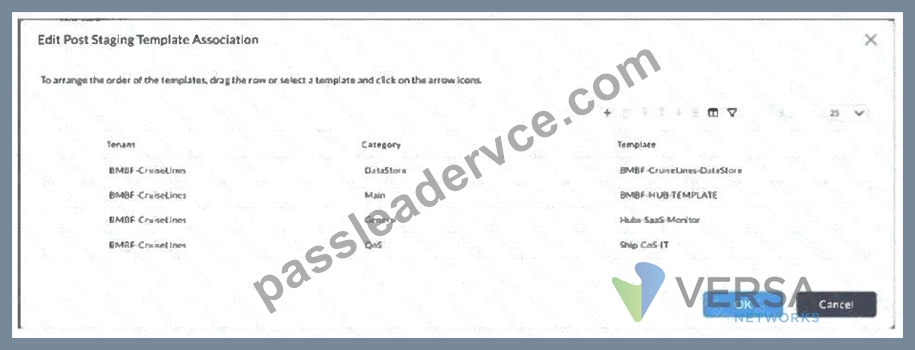
- A. The device configuration will automatically create two copies of the same Address object.
- B. The device configuration commit will fail.
- C. The device configuration will have the Address object that was created last.
- D. The device configuration will have the version of the Address object in the QoS template.
Answer: D
Explanation:
The correct answer is D . In the displayed post-staging
template association order, the device template BMBF- TEMPLATE is applied before
the QoS service template Ship-CoS-IT . Versa documentation explains that device
templates, also called post-staging templates, provide the baseline
configuration for devices, while service templates are service-specific
configurations that can be applied to device configurations. It also states that
service templates are associated with device groups and that, in a device group,
the administrator can choose the order in which service templates are
applied.
Because the QoS template is later in the shown association order,
the final merged device configuration uses the Address object definition from
the QoS template when the same object name exists in both templates. It does not
automatically create two copies of the same Address object, because the object
name is the key for the configuration element. It also should not fail merely
because the same object name exists in a later template; the merge behavior
resolves the effective configuration according to the template order. Therefore,
the onboarded hub device receives the Server Address object version from
Ship-CoS-IT, the QoS template.
NEW QUESTION # 24
A branch has correct underlay speed
and no asymmetric SD-WAN paths, but users still report packet loss during large
transfers. You suspect QoS shaping is dropping traffic. Which command is most
appropriate to verify interface-level CoS drops?
- A. show cgnat tenants
- B. show system uptime
- C. show alarms last-n 10
- D. show class-of-services interfaces detail interface-name
Answer: D
Explanation:
The correct answer is A . Versa throughput troubleshooting
documentation includes a specific section titled Check that Packets Are not
Dropped by CoS . It states that if a CoS shaper or rate limiter is configured on
the VOS device, it may drop packets when traffic exceeds the configured shaping
rate. To check whether CoS is dropping packets, Versa recommends commands
including show class-of-services interfaces brief and show class-of-services
interfaces detail interface-name.
The detailed interface output displays
traffic statistics such as TX packets, TX packets dropped, TX bytes, TX bytes
dropped, and per-traffic-class drops. This is exactly the evidence needed to
confirm whether shaping or QoS enforcement is causing the observed loss.
show
alarms last-n 10 may reveal major events but will not provide per-interface CoS
drop counters.
show system uptime only indicates how long the system has been
running. show cgnat tenants is relevant for NAT state and tenant CGNAT
resources, not QoS drops.
NEW QUESTION # 25
An SD-WAN branch is deployed behind a
NAT device. In the VSM local-tunnel-site output, which field or flag indicates
that a WAN link is behind NAT?
- A. Tenant ID only
- B. WAN lcl vrf-id only
- C. WAN lcl link behind NAT or BN flag
- D. Neighbour site type only
Answer: C
Explanation:
The correct answer is A . Versa SD-WAN data-path
troubleshooting documentation shows the VSM local- tunnel-site output and
includes a legend in which BN means Behind NAT . In the WAN local link details,
the output also displays a field named WAN lcl link behind NAT , with values
such as 1 or 0, and link flags including [ BN CT PT SLA-P ] when the WAN link is
behind NAT.
This information is important because NAT status affects how
SD-WAN tunnel endpoints are discovered and how public and private transport
addresses are represented. The same output includes both public and private WAN
link addresses, making it useful for troubleshooting sites behind NAT, stale
tunnel endpoints, or incorrect public-address learning.
WAN lcl vrf-id
identifies the local transport routing instance ID, not NAT status. Tenant ID
identifies the tenant context. Neighbour site type identifies whether the remote
endpoint is a Controller, hub, or SD-WAN site. None of those fields specifically
confirms whether the local WAN transport is behind NAT.
NEW QUESTION # 26
Examine the exhibit below.
You are
configuring an IPsec tunnel towards a non-SD-WAN site over the INETTransport-VR.
The site IP address is 10.1.1.1. This tunnel is for traffic between the
192.168.100.0/24 and the 192.168.200.0/24 LAN networks. The tunnel does not
establish.
Referring to the exhibit, which statement is correct?
- A. The Policy Configuration is missing an additional policy with the subnets swapped.
- B. The Tunnel Routing Instance is incorrect.
- C. The Routing Instance should be changed to global.
- D. A precedence higher than 0 needs to be set.
Answer: B
Explanation:
The correct answer is A . The exhibit shows that the IPsec
VPN is being configured with Tunnel Routing Instance: XIAN-Control-VR . However,
the question states that the tunnel is toward a non-SD-WAN site over the
INET-Transport-VR . For a site-to-site IPsec tunnel, the tunnel routing instance
must match the routing instance used to reach the peer public IP address. In
this case, the remote non-SD-WAN peer is
10.1.1.1 , and the intended underlay
transport is INET-Transport-VR , not the Control VR.
Versa troubleshooting
documentation explains that routing instances are used to define where traffic
is sourced and forwarded. For example, configuration examples select routing
instances when enabling services or initiating tests, and traffic must use the
correct WAN or transport routing instance to reach the remote endpoint. Versa
branch troubleshooting also emphasizes that after transport connectivity is
available, the branch establishes IKE-based IPsec connectivity; if that
connectivity fails, the IPsec-related interface remains down.
Changing the
routing instance to global would not be correct because the intended path is
specifically INET-Transport-VR. A higher precedence value is not required to
establish the tunnel. The policy selector shown already defines local-to-remote
interesting traffic, and the key failure is the incorrect tunnel routing
instance.
NEW QUESTION # 27
......
Though our VNX301 training guide is proved to have high pass rate, but If you try our VNX301 exam questions but fail in the final exam, we can refund the fees in full only if you provide us with a transcript or other proof that you failed the exam. We believe that our business will last only if we treat our customers with sincerity and considerate service. So, please give the VNX301 Study Materials a chance to help you.
Clearer VNX301 Explanation: https://www.passleadervce.com/Administrator-SD-WAN-Specialist/reliable-VNX301-exam-learning-guide.html
- Versa Networks VNX301 Free Updates 🧶 Search on ⇛ www.pass4test.com ⇚ for “ VNX301 ” to obtain exam materials for free download 🏬High VNX301 Quality
- VNX301 Pdf Version 😌 Exam VNX301 Passing Score 🗯 VNX301 Pdf Version 🎡 Easily obtain free download of ➽ VNX301 🢪 by searching on ➤ www.pdfvce.com ⮘ 🏋VNX301 Valid Cram Materials
- Get Help from Real and Experts www.easy4engine.com Versa Networks VNX301 Practice Test 🎑 ⇛ www.easy4engine.com ⇚ is best website to obtain ☀ VNX301 ️☀️ for free download 🎿VNX301 Dump Torrent
- Comprehensive Versa Networks VNX301 Exam Questions in PDF Format 🕴 Download ✔ VNX301 ️✔️ for free by simply searching on ⮆ www.pdfvce.com ⮄ ☂High VNX301 Quality
- VNX301 Valid Study Questions ➿ VNX301 Dump Torrent 💄 Exam VNX301 Objectives Pdf 🧟 Go to website ➠ www.vce4dumps.com 🠰 open and search for ( VNX301 ) to download for free 🕒VNX301 Valid Test Notes
- VNX301 Valid Cram Materials ⛪ Reliable VNX301 Exam Braindumps 🌮 Exam VNX301 Objectives Pdf ⚽ The page for free download of 「 VNX301 」 on ➠ www.pdfvce.com 🠰 will open immediately 🦌VNX301 Valid Study Questions
- Use VNX301 Exam Questions - Best Way To Get Success 🔟 Copy URL ➽ www.verifieddumps.com 🢪 open and search for ⏩ VNX301 ⏪ to download for free 🤥Reliable VNX301 Exam Braindumps
- 100% Pass Quiz 2026 VNX301: Efficient Versa Certified SD-WAN Specialist (VNX300) Valid Test Practice ☸ Search for ➤ VNX301 ⮘ and download it for free on [ www.pdfvce.com ] website 🛫Study VNX301 Tool
- Use VNX301 Exam Questions - Best Way To Get Success 😧 Search for ⏩ VNX301 ⏪ and download exam materials for free through ➤ www.pdfdumps.com ⮘ 🧫VNX301 Reliable Test Experience
- VNX301 Questions - Pass On First Try [2026] 🚰 Search for 「 VNX301 」 and download exam materials for free through ▶ www.pdfvce.com ◀ 🚥Reliable VNX301 Exam Braindumps
- VNX301 Exam Syllabus 🆗 High VNX301 Quality 📩 Valid Exam VNX301 Braindumps 🛢 Go to website ▷ www.testkingpass.com ◁ open and search for [ VNX301 ] to download for free 🐪Valid VNX301 Exam Test
- myportal.utt.edu.tt, myportal.utt.edu.tt, myportal.utt.edu.tt, myportal.utt.edu.tt, myportal.utt.edu.tt, myportal.utt.edu.tt, myportal.utt.edu.tt, myportal.utt.edu.tt, myportal.utt.edu.tt, myportal.utt.edu.tt, myportal.utt.edu.tt, myportal.utt.edu.tt, myportal.utt.edu.tt, myportal.utt.edu.tt, myportal.utt.edu.tt, myportal.utt.edu.tt, myportal.utt.edu.tt, myportal.utt.edu.tt, myportal.utt.edu.tt, myportal.utt.edu.tt, myportal.utt.edu.tt, myportal.utt.edu.tt, myportal.utt.edu.tt, myportal.utt.edu.tt, myportal.utt.edu.tt, myportal.utt.edu.tt, myportal.utt.edu.tt, myportal.utt.edu.tt, myportal.utt.edu.tt, myportal.utt.edu.tt, myportal.utt.edu.tt, myportal.utt.edu.tt, myportal.utt.edu.tt, myportal.utt.edu.tt, myportal.utt.edu.tt, myportal.utt.edu.tt, myportal.utt.edu.tt, myportal.utt.edu.tt, myportal.utt.edu.tt, myportal.utt.edu.tt, myportal.utt.edu.tt, myportal.utt.edu.tt, myportal.utt.edu.tt, myportal.utt.edu.tt, myportal.utt.edu.tt, myportal.utt.edu.tt, myportal.utt.edu.tt, myportal.utt.edu.tt, myportal.utt.edu.tt, myportal.utt.edu.tt, myportal.utt.edu.tt, myportal.utt.edu.tt, myportal.utt.edu.tt, myportal.utt.edu.tt, myportal.utt.edu.tt, myportal.utt.edu.tt, myportal.utt.edu.tt, myportal.utt.edu.tt, myportal.utt.edu.tt, myportal.utt.edu.tt, myportal.utt.edu.tt, myportal.utt.edu.tt, myportal.utt.edu.tt, myportal.utt.edu.tt, myportal.utt.edu.tt, myportal.utt.edu.tt, myportal.utt.edu.tt, myportal.utt.edu.tt, myportal.utt.edu.tt, myportal.utt.edu.tt, myportal.utt.edu.tt, myportal.utt.edu.tt, myportal.utt.edu.tt, myportal.utt.edu.tt, myportal.utt.edu.tt, myportal.utt.edu.tt, myportal.utt.edu.tt, myportal.utt.edu.tt, myportal.utt.edu.tt, myportal.utt.edu.tt, scalar.usc.edu, divisionmidway.org, myportal.utt.edu.tt, myportal.utt.edu.tt, myportal.utt.edu.tt, myportal.utt.edu.tt, myportal.utt.edu.tt, myportal.utt.edu.tt, myportal.utt.edu.tt, myportal.utt.edu.tt, myportal.utt.edu.tt, myportal.utt.edu.tt, myportal.utt.edu.tt, myportal.utt.edu.tt, myportal.utt.edu.tt, myportal.utt.edu.tt, myportal.utt.edu.tt, myportal.utt.edu.tt, myportal.utt.edu.tt, myportal.utt.edu.tt, myportal.utt.edu.tt, myportal.utt.edu.tt, myportal.utt.edu.tt, myportal.utt.edu.tt, myportal.utt.edu.tt, myportal.utt.edu.tt, myportal.utt.edu.tt, myportal.utt.edu.tt, myportal.utt.edu.tt, myportal.utt.edu.tt, myportal.utt.edu.tt, myportal.utt.edu.tt, myportal.utt.edu.tt, myportal.utt.edu.tt, myportal.utt.edu.tt, myportal.utt.edu.tt, myportal.utt.edu.tt, myportal.utt.edu.tt, myportal.utt.edu.tt, myportal.utt.edu.tt, myportal.utt.edu.tt, myportal.utt.edu.tt, mayagriffiths253.blogspot.com, myportal.utt.edu.tt, myportal.utt.edu.tt, myportal.utt.edu.tt, myportal.utt.edu.tt, myportal.utt.edu.tt, myportal.utt.edu.tt, myportal.utt.edu.tt, myportal.utt.edu.tt, myportal.utt.edu.tt, myportal.utt.edu.tt, myportal.utt.edu.tt, myportal.utt.edu.tt, myportal.utt.edu.tt, myportal.utt.edu.tt, myportal.utt.edu.tt, myportal.utt.edu.tt, myportal.utt.edu.tt, myportal.utt.edu.tt, myportal.utt.edu.tt, myportal.utt.edu.tt, Disposable vapes
DOWNLOAD the newest PassLeaderVCE VNX301 PDF dumps from Cloud Storage for free: https://drive.google.com/open?id=1VOL4CGz8HyWX_2TJUypwWow0zs5qgdba


Comments
Post a Comment